
By Garrett Cronin, Commercial Director, DataBuilders
In today’s fast-paced digital landscape, the ability to access data the moment it’s needed is no longer a luxury, it’s a necessity. Traditional methods of moving data through complex ETL (Extract, Transform, Load) pipelines often results in delays and stale information. This is where Data Virtualisation comes in.
What is Data Virtualisation?
Data Virtualisation is a technology that enables real-time access to data workflows without the need for data duplication or manual exports. Instead of moving data into a new physical location, it creates a “virtual” bridge between your data sources and the systems that need them.
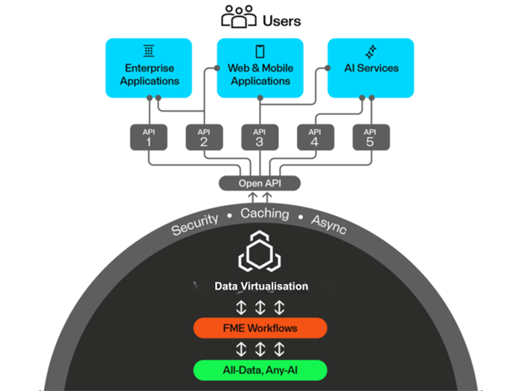
Using the FME Platform, Data Virtualisation turns FME workflows into secure, reusable API endpoints. When a request is made to an API, the system runs the connected workspace in real time, processes the data, and returns the results immediately in the requested format, such as JSON, XML, or CSV.
Key Benefits
Adopting a data virtualisation strategy offers several transformative advantages for an organisation:
- Faster Decision-Making: Teams gain instant access to live data, eliminating the wait times associated with traditional ETL delays.
- Lower Operational Costs: By streaming data directly from the source, organisations can reduce the need for expensive storage infrastructure and extensive development efforts.
- Enhanced Governance and Security: It allows for authenticated, role-based access to sensitive datasets, ensuring compliance while maintaining interoperability between legacy and modern systems.
- Increased Productivity: With a no-code platform, both technical and non-technical users can build and deploy enterprise-grade APIs efficiently.
- AI Readiness: It connects every system and AI model to the real-time, structured data required for intelligent automation.
Real-World Applications
Data Virtualisation is ideal for organisations looking to modernise their data sharing without replacing existing infrastructure. Common application scenarios include:
- Live Dashboards: Delivering “always-current” data to internal applications and business intelligence services.
- Public and Partner Portals: Sharing standardised information securely across different departments or with external partners.
- Powering AI Workflows: Providing generative AI models with structured, up-to-date data for more accurate automation.
- Industry-Specific Needs: Helping sectors like utilities, healthcare, and finance maintain control over critical information while making it accessible for operational needs.
Technical Excellence
The framework supports high-performance standards, including built-in caching to speed up responses and asynchronous processing for complex, long-running jobs. Furthermore, every API is automatically documented using OpenAPI standards, providing a professional interface for testing and integration with other enterprise systems.
By leveraging Data Virtualisation, you can turn your FME workflows into powerful, shareable data services that drive innovation and efficiency across your entire organisation.
For a demo or further information on Data Virtualisation within the FME Platform, please get in touch.